David Armstrong Six
INTERVIEW PAR MARC MAYER
Avril 2026
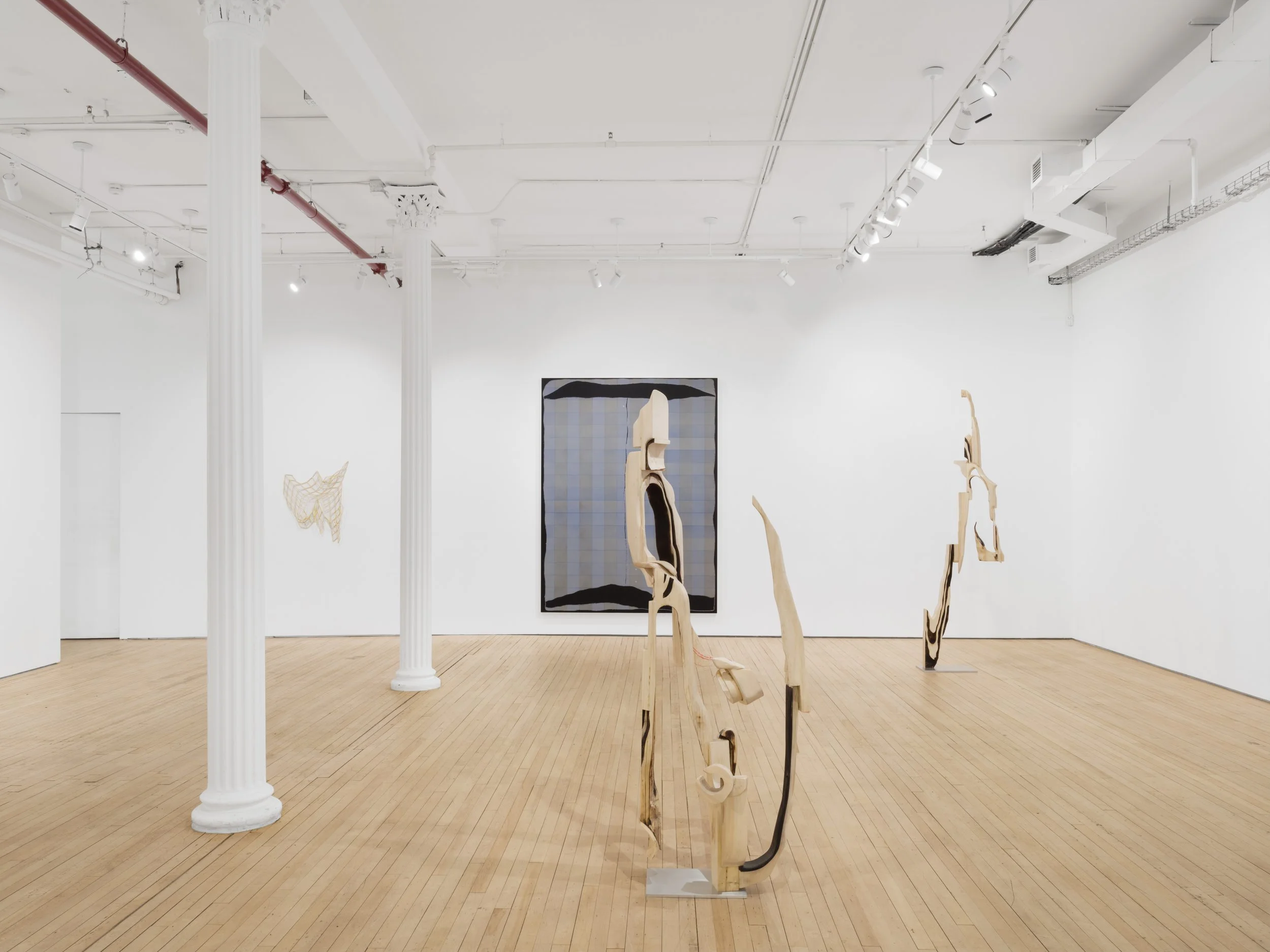
Braided River, group exhibition, Arsenal Contemporary New York, David Armstrong Six
Marc Mayer: Were you always going to be an artist, or did you once have other plans?
David Armstrong Six: No, I mean who can say “always”, but also yes, somehow, in a weird way…
I was always drawing as a child, and would pour over my father’s sketchbooks of movie stars like Ava Gardner smoking cigarettes in silk gowns and watercolours of Cairo that he did during the war (WWII). To this day I still consider him to be the most impeccable draughtsman.
After the war, he emigrated from Great Britain to Canada to escape the social class system. He never had the luxury of being an artist officially, but in my mind he was. He was always busy with different projects and used to tell me that he worked at the mine so he could afford to play. He was also quite old. My parents had me very late in life, but that never slowed him down.
I remember he would design and build small sailboats for example, then someone bought one and other people started placing orders because it was a very fast sailboat, then he’d lose all interest. Same thing with audio speakers. Then it was field recordings; shoeboxes and shoeboxes of cassette tapes, recordings of nothing really, just wind, birds and stuff. Then it was photography and he built this amazing darkroom, which I was also keen on. Then he became an amateur radio operator. But everything he did, he did exceptionally well.
So, in essence, it was his sense of rigour, insatiable curiosity, and meandering mind which inevitably stuck with me as the model for becoming an artist.
Beckett has this great quote that “words are the clothes thoughts wear”. For me it was just trying different outfits in the change room, and figuring out what I felt most comfortable in.
I had a prodigious career as an adolescent poet and was published in some literary journals by the age of seventeen. So that was a consideration. But eventually, yes, it was Fine Art that I pursued at university.
Recently, I stumbled upon a Paul Auster interview. He was talking about the absurdity of how much time you spend alone in a room as an artist just figuring things out. Then he said something like, “But you never see an artist having regrets about how they spent their time before death ...it’s not like they say, “Oh, I wish I had spent that time differently. I wish I had been a judge, or an accountant, or whatever”… but the reverse may be true, wherein those who spent a lifetime dedicated to other types of jobs might think, “Oh, I wish I had been an artist”. To that end, it is not an easy life. There was a moment in my early 40’s when I thought I should pivot to a stable vocation, but then came to my senses and realized there is nothing else I could do really, or want to do, let alone do well, or enjoy so much. As Bob Rae was fond of saying, “You can’t put toothpaste back in the tube.” I was too far gone at that point.
MM: How did you settle on sculpture and are you committed to that medium long-term?
DAS: I was trained as a painter and persevered in an entirely private manner for 8 years after university, painting every day in a spare bedroom of our apartment at the time in Toronto, large scale canvases in oil. I was incredibly invested, and certainly not shy on youthful arrogance. I thought I would become the next Richter or something…I mean I definitely had some licks, but not on that level. The turning point came when I secured my first official artist studio. Then the works started coming off the wall as physical constructions, although I still considered them to be firmly rooted in the tradition of painting, there was no denying that they had become inherently sculptural. I really liked how those constructions expanded all perceptual possibilities, and what that did to my body, and the different ways I had to move around to negotiate them.
Then Loretta Yarlow came for a studio visit, which was also my fist official studio visit, and these sculptural wall constructions were included in a group exhibition she was curating at AGYU called “Implicating Possibilities”, and that was my first show. I never did exhibit the paintings.
In answer to your question: yes, definitively, and passionately. Although I flirt with a bunch of other stuff, sculpture is what truly seizes my attention, over and over again.
MM: Your sculptures seem perfectly calibrated between additive and subtractive. I can’t decide which is the dominant mode. Is this intentional?
DAS: “Perfectly calibrated” kind of makes me laugh, I mean they are indeed, absolutely: but the origin of what aggregates through process into the final composition is often highly unwieldy, improbable even. If there was CCTV in the studio you would see how instinctual and potentially hilarious the whole process is: it probably resembles slapstick comedy more than anything else, but yeah, additive, subtraction… there is always this push and pull which gets sustained as a critical tension, which is often so much about activating the agency of negative space as part of the composition somehow.
I will often persevere stubbornly for months at work which keeps bothering me. Then there is this duh moment, only to realize that it is a particular passage which may be entirely virtuosic that is the problem; that is what was clogging the experiential flow. Like I was trying to be too clever or something, and that is what inevitably gets revealed as forced or pretentious, and needs to be removed.
That’s also why you see so many battle-scars embedded within the finished work, which are not rogue signifiers. I keep these in place while working on a piece as a type of reminder, in case, I may want to change my mind, perhaps I don't know. Often, they survive and get subsumed as part of the sculpture. They have a life there, they are sincere, thus allowed to exist.
MM: I know you to be a lover of music and literature. Are there other art forms that you’re passionate about, and do they inform your own creativity?
DAS: Umm, yeah, I mean cinema for sure, but I don't really think about them much in a conscious way.
My disposition has more to do with their aura or afterimage.
What those other art forms do is provide inspirational prompts, or provocations, as a background radiation. Sometimes it is a stimulating passage I had read earlier that day. I have an incredible CD collection. So often, I will start each new session in the studio by playing a certain album as a catalyst, to invoke a fresh perspective, or maybe it indexes where my mind left off the night before …past that, all that stuff just flows through me, but also becomes me in some way.
There is this terrifying thrill when you encounter a great work of art for the first time: I mean those moments when you feel like falling on your knees and drooling in front of a masterwork. Regardless of the medium or taste, it always comes back to this avalanche of untraceable thinking, like how did they get “there”? There is no real beginning or end in discovery or curiosity, just surrender. So I’m careful to surround myself with the comfort of awe-inspiring models, whether they be historical or contemporaneous. It all gets absorbed in the hope of getting “there” myself, as myself.
MM: Your sculptures can seem monstrous on first impression, like something that’s been destroyed or creatively vandalized, but with a bit of sustained looking they soon become lyrical and seductive. Is this a deliberate strategy?
DAS: Sometimes a sculpture does literally get vandalized, by me, out of frustration, when I need to rupture where it is going. It is all about sustaining experiential encounters for sure, which necessitates various types of seduction as part of the dance. But there is definitely no strategy, no script really: just a tenancy to the studio, and the daily build of a specific state of mind, which gets nurtured as a protracted narrative arc, so that the sculpture can keep surprising me in some way.
There has always been this nebulous tension built into the work, oscillating between figuration and abstraction. The sculptures evolve insidiously, within a larger overarching fascination with materiality and morphosis. They are also quite perverse and very fetishist. Their existence is predicated on association. There is no either/ or. There is no fixed symbolism here. In this way the sculptures should be regarded as nascent forms, in a perpetual state of becoming.
That being said, I am incredibly sensitive to the idea of beauty, which inescapably cultivates notions of longing, which does have the capacity to be monstrous, in a spectral way. I can’t stop thinking about that line in Rilke’s poem, ‘To Lou Andreas-Salomé”: “longing leads out far too often into vagueness”
MM: Is space a consideration for you while you’re working, or are your forms autonomous with regard to space?
DAS: It used to be... In fact what I am doing now is the total reverse of where it began. My preoccupations back then were with a type of experimental presence that was definitively more immersive and ephemeral. They had a strangely performative, almost kinetic quality, especially when considered within a context of geological time. I did an exhibition at Plugin in Winnipeg in 2000 called “The Soup” for example, which was comprised of a large drop ceiling, 44 x 16 feet. Except in place of those conventional office tiles, I had inserted clear Plexiglas panels throughout the grid. Then I had cooked up an absurdist mixture of translucent and viscous liquids, like corn syrup, jelly spreads, and vaseline etc. in a giant pot, like well over 200 gallons of the stuff, which was then poured over the ceiling. Because of the mucus-like viscosity of the liquid matter, it would settle and seep through the seams of the drop-ceiling in an excruciatingly slow manner, forming these trippy stalactites, which eventually reached the floor. I remember there was a brief Burroughs passage about boredom as a creative force, which sufficed as the artist’s statement for that show. Shortly thereafter I did another version in smoked Plexiglas as a viaduct-like structure in Chelsea, at Andrew Kreps Gallery actually, who has since relocated and is now your gallery neighbour. There were other works too which fed off the architecture as a sculptural precondition; wherein I was projecting the object as a predator, onto or into the space as a host. I also remember being interested in this notion of indifference as a liberating aesthetic gesture at that time, which was achieved through the act of putting something in motion, such as the syrup/ soup, or injecting yogurt into wood in order to cultivate mold, only to let it evolve on its own terms. So it didn’t belong to me anymore. In fact, there are other examples which almost led to serious disaster, which I will refrain from mentioning here.
At a certain point, although still monumental and immersive, the sculptures became more about compositional form and their own construction. Then, in a very incremental, but no less experiential way, they slip-knotted into the autonomous object; most decisively during that year in Berlin (2012), which was a significant turning point.
Currently it is all about a fourth-dimensional encounter with the other, which for me, hinges off some kind of creatural counterpoint, as the sculpture itself. I tend to work marathon shifts in seclusion throughout the night, and often feel lonely in the outside world, but am never lonely in the studio. In fact, it is the only place the world makes sense.
MM: Do you have an ideal viewer? If so, how would you describe them?
DAS: Yes, me. Because I believe in the urgency of poetry, and am an unwavering romantic. I’m also a total fucking hard-ass.